
Aqua-Centre
SERD, AIT, PO Box 4
Klong Luang, Pathumthani 12120
Thailand
ph: 662 524 5222
fax: 662 524 6200
alt: 66817346934
Director


Projects
Aquaculture program at AIT started in 1981. Since then there was a culture of designing projects and raising funds to implement on-station and on-farm research projects. AIT's aquaculture was established with the support of ODA (Overseas Development Agency) of UK, now it is DFID (Department of Internaitional Development). Since then, other donors followed such as USAID (Pond dymanics/CRSP), DANIDA (curriculum development), SIDA (Outreach programs) and so on. Later on more projects were funded by various donors such as European Union, IDRC, GTZ, WorldFish (Formerly, ICLARM), and others.
With these projects and along with students thesis reserach, waste-water fed aquaculture, integrated farming, fertilization techniques and green water pond culture, hapa nursing, sex-reveral of tilapia fry, hapa breeding, technologies were developed. A lot of efforts were also made to transfer these technologies to the communities establishing outreach centres in north east of Thailand, Cambodia, Lao PDR, and northern and southern Vietnam contributing to food and nutrition security of the rural communities.
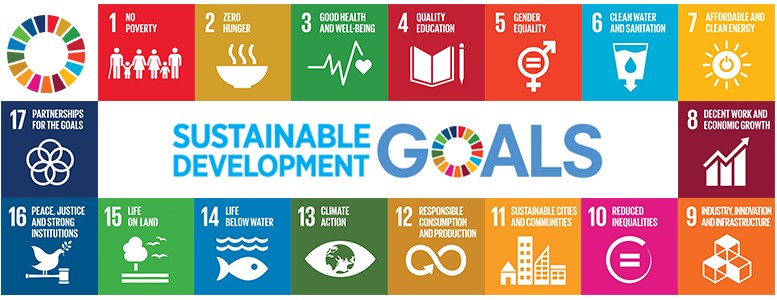
Our on-going and past projects have tremendously contributed to SDGs especailly Goals 1, 2, 4, 5, 8, 14 and 17. Development and exchange programs related to high quality education, research, training, and community development are fully aligned to these goals. We continue to lead in this sector and contribute to the UN's sustainable goals. This webpage along with others, serve as evidences of what we do.
Curriculum development program:
AIT has played very prominent role in curriculum and institutional capacity development in addition to individual's skill in Indochina or Mekong region especially Cambodia, Loas, Thailand and Vietnam. Building on this, Aqua-Centre is expanding AIT's activities in Myanamar, Bangladesh, India, Nepal, Pakistan, and even to Afrian countries such as Kenya, Nigeria, Uganda, Zambia and so on. A number of projects in the past were implemented supporting thousands of teachers and students of universities and colleges have benefitted. Amongs the projects, EU supported Asia Link program with curriculum devleopment started since 2005-2008 and the second phase was from 2008-2010. More recent one is the curriculum development for Sustainable Seafood and Nutrition Security (SSNS) which is funded under Erasmus+ programme for three years (Oct 2017- Oct 2020). A total of 13 partners (4 from Europe and 9 from Asia) work together with the purpose of developing MSc curricula on Sustainable Seafood and Nutrition Security.
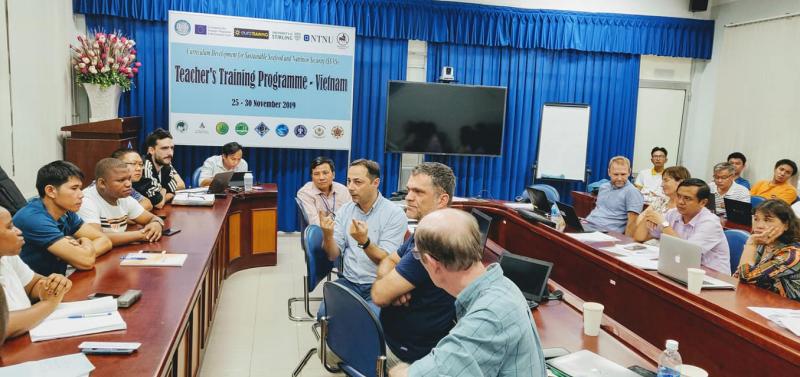
Teacher's training program (November 26-29, 2020) in Vietnam as a part of curriculum development for Sustainable Seafood and Nutrition (SSNS) project funded by Erasmus+ programme of the European Union
Strategic focus on tilapia farming and its promotion:
One of the remarkable technologies developed at AIT and commercialized is the tilapia hatchery technology. A series of research trials were conduced to select the incubation jars such as coke bottles, white water bottles, locally-made fibre glass jars, etc., comparing breeding systems such as traditional pond method, tanks, and hapas. Atempts were made to commercialize the technology. Nam Sai Farms International is one of the most successful tilapia hatchery project which started in 1994 signing a 5- year agreement with AIT. Due to its success, few private entrepreneurs started to adopt, and more people starting learning through training programme and technical assistance. As a result, there are thousands of tilapia hatcheries around the world including in Bangladesh (>500), Thailand (>100), Vietnam, India, Pakistan, Indonesia, the Philippines, Cambodia, Laos, Nepal, Kenya, Zambia, Uganda, Mozambique, Nigeria, Mali, etc. Due to tilapia farming technologies, AIT is well-known in aquaculture sector around the globe, especially among the tilapia farmers.
Through these efforts, it was well-established fact that aquaculture is easy to do and profitable as compared to most of the other sub-sectors of agriculture. Most fishes are white meat and the best protein as they contain all the amino acids required by human and othe ranimals. Malnutrition can be solved if rural families grow fish even in a small ponds of 200 m2 with stocking 400-500 fish which they can eat few fish every week. Therefore, one farmers one pond should be hte slogan for rural village. We implement model fish farms and villages to show other farmers and train.
In some countries and some parts witin each country, aquaculture has taken off. It createed plenty of jobs, for exmple, 100-200 staff are normally employed by a single tilapia hatchery. Thousands of women work in a single factory in Pangasius processing plant in Vietnam. Feed industry well developed which employs many people for raw matter acquisition, in feed making process and transportation of feed to farmers.
Fast growing aquaculture is facing several challenges of sustainability, checmical use and pollution caused by industrial development. Therefore, recent research projects are to contribute to the sustainable development of aquacutlure and fisheries management. Continued research and development of tilapia farming; low-cost hatchery technology, hapa nursing, and green water grow-out systems are still the major areas. Others areas include use of phytogenic compunds in fish feed, use of insect meal to replace fishmeal, alternative to MT hormone for sex-reversal of tilapia fry, use of local vegetables aquaponic system combining nursing and hatchery systems.
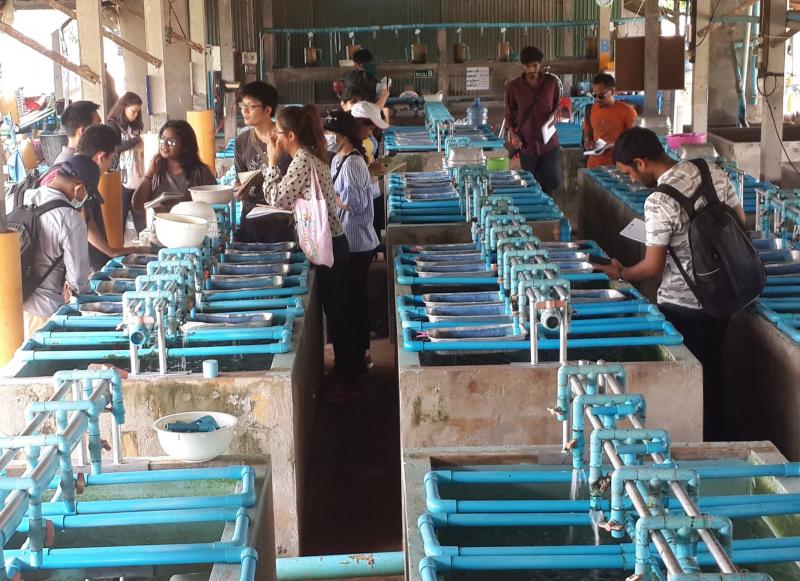
Nam Sai Farm Tilapia hatchery which was established with a joint agreement to use AIT technology. There are 7 units like this as shown above which produce over 20 million monosex fry per month.
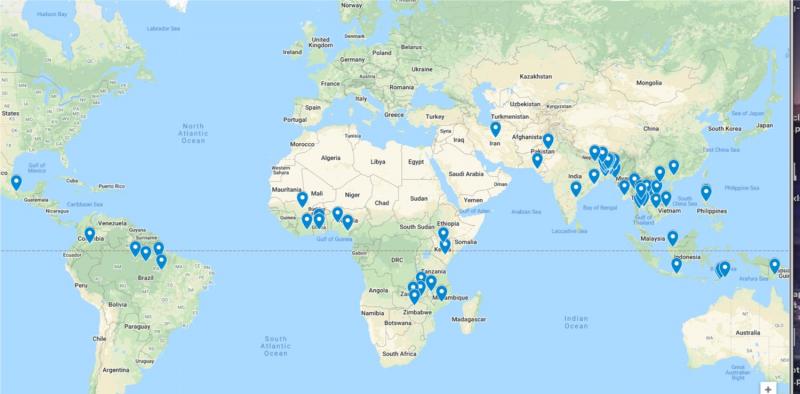
This technology has been well taken up by the private sector as a good business. It is spreading all over the world as shown in the map beolw; starting from Fiji, Papuwa New Guinea, East Timor, the Philippines, Indonesia, Malaysia, Vietnam, Cambodia, Laos, Thailand, Myanmar, Bangladesh, India, Nepal, Pakistan, Iran, Kenya, Uganda, Zambia, Zimbabwe, Mozambique, Nigeria, Mali, Brazil, Colombia, Mexico and others.
Community development projects: Bangladesh, Cambodia, Pakistan, Nepal, Myanmar, etc.
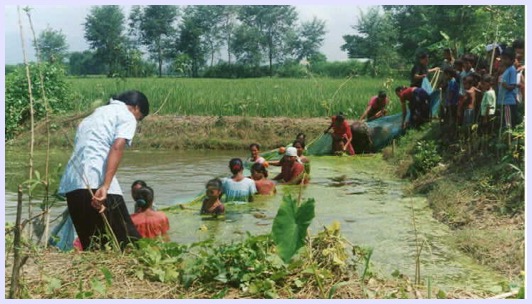
Women in Aquaculture in Nepal

List of projects
1. Growing Seafood in the Lab (GSIL) project has been initiated in collaboration with Shiok Meats Pvt, Ltd., Singapore – Budget 11.95 million Baht Period: Dec 1, 2021 – Nov 30, 2026.
2. Testing of commercial feed additives of Lucta in Tilapia (TAFL) -– testing products against aflatoxins in tilapia feed sponsored by a private company, Lucta companyheadquartered in Spain and branch in China: 1 Jun 2021 - 31 May 2022 (1.35 mil Baht).
3. Aqua-Agri Workshop/conference in New Normal (AAWIN)– initiated with the estimated Budget of about 0.8 million Baht. Sep 2020 – Dec. 2022.
4. BRAC Fish - technology transfer to BRAC Fisheries, Bangladesh, Aug 2020-July 2023. Budget 0.8 million Baht.
5. Aqua-Dev, Nepal - upgrading aquaculture farm through technology transfer to Vaidya group, budget 1.7 million Baht - Aug 2020-July 2023.
6. Aqua-Internship provide 3-months training to 10 students of College of Fisheries, Odisha University of Agriculture and Technology (OUAT), Odisha, India. Budget approx. US$56,000.
7. SOS - Sun-Oxygen-System: Energy efficient fishpond aeration enhancing integrated small-scale farming in Cambodia, ZHAW, Switzerland and Smiling Gecko Cambodia (SGC). 2020-2022. Budget CHF45,500.
8. TALAT, Pakistan: Tilapia hatchery project in Karachi, Pakistan with LAARH, 2019-2022.L Budget 1.2 million Baht.
9. ATF - Aflatoxins in tilapia feed – testing products of Patent company (Serbia) as solution 15 Dec 2020 - 31 Dec 2021 (0.7 mil Baht).
10. Curriculum Development for “Sustainable Seafood and Nutrition Security (SSNS), Indonesia, Thailand and Vietnam in collaboration with European partners in Greece, Norway and UK. Oct 2017- Dec 2021: 36+12 months with Budget approx. 999,556 Euro.
11. Ex-Mad: Exchanges, Training and Study tour for Madagascar group. Dec 2019-Jun 2020.
12. Testing Feed pellet stability funded by Anpario Co., UK. Budget GBP10,170.
13. Testing of commercial products (feed additives) in tilapia diet to replace fishmeal funded by Biomin Holding, GbmH, Austria. Budget 41,248 Euro (Jan 2018-Dec. 2019).
14. Testing of commercial phytogenic products in tilapia funded by Delacon Company based in Austria. Budget 13,179 Euro (Jan 2018-Dec. 2019).
15. Aquaculture Training, Workshop & Tours (AquaTT), Budget 3.954 million Baht. (Nov 2017-Nov. 2018).
16. Tilapia Training and Workshop, Budget 3.1654 million Baht (Dec 2016-Nov 2017).
17. Aqua-Tech., Aquaculture and agriculture related training and study tours (2014 – 2016): Budget approx. US$100,000.
18. Fish farming for income generation in Preah Vihear, Cambodia funded by JCI, Japan, Jan – Dec 2017.
19. Testing of Feed Supplements: A series of research on feed supplement products with Biomin Holding Company headquartered in Vienna, Austria (2016 Jan – Nov 2017).
20. Aqua-Dev: Aquaculture and agriculture related training and study tours (2014 – 2016) – Budget approx. US$150,000.
21. Myanmar-Dev. (2013-2014), Rakhine Myanmar funded by OXFAM, UK, Budget US$100,000.
22. Development of Rural Aquaculture through Entrepreneurship in Women in Myanmar (eWomen), Foreign Affairs Ministry, Govt. of Italy, 2013, Budget ~EUR332,000.
23. Sustainable Aquaculture Research Network for Sub-Saharan Africa (AIT component) – funded by EU under FP7 program 2008-2011 (Budget Euro 996,036, 2 European and 5 Asian partners in Bangladesh, Cambodia, Nepal, Thailand and Vietnam).
24. Linking the post-graduate education in aquaculture and aquatic resources management with its industries through internship program. (Euro 959,157, Sept 2007 – Aug 2010).
25. Empowering women through aquaculture and vegetable gardening in rural areas funded by Aquaculture without Frontiers (AwF), Jan 2007 – Dec 2009 (US$9,259).
26. Asia Link Project (Euro 386,957). Title: “Improving Master’s Degree level education in Aquaculture and Aquatic Resources Management in Cambodia, Nepal and Vietnam” – Partners – University of Stirling (UK), Univ. of Aveiro (Portugal), Royal Univ. Of Agriculture (Cambodia), IAAS (Nepal), Uni. Of Forestry and Fisheries (Ho Chi Minh, Vietnam), Research Aquaculture No. 1 (Hanoi, Vietnam).
27. Women in Aquaculture in Nepal project funded by Canadian Cooperation Office (2006 -2008 (Phase III: ~CAD35,000)
28. Women in Aquaculture in Nepal project funded by WDP-German Committee (2000 -2002 (Phase I: 25,000 US$) and 2002 – 2004 (Phase II: 28,000 US$).
29. Post-Doc. Research/Publication (2002) from DFID, UK (~£10,000).
30. Exotic fish species in SE Asia – Problems and Prospects”, funded by SIDA, 2000-2001 (~30,000 US$).
31. Support from AgriBrands/Cargill Inc. and Nam Sai Farm Co. Ltd., for Post-doc research on effects on lipids on fish eggs and fry (Approx. US$30,000).
32. Support from Narai Technologies and Nam Sai Farm Co. Ltd., for doctoral and Post-doctoral research (approx. 100,000 US$). 1994-1999.
Aqua-Centre
SERD, AIT, PO Box 4
Klong Luang, Pathumthani 12120
Thailand
ph: 662 524 5222
fax: 662 524 6200
alt: 66817346934
Director